
Improving awareness, understanding, and conservation of historically common, but now imperiled coastal grassland habitats.
who
we are

We are working to understand the effects of common restoration and management practices for coastal upland habitats on ecological communities, focusing on vegetation, birds, reptiles, and mammals.
Programs
Ecological response to habitat restoration and management


The Coastal Upland Restoration & Ecology Program is working to manage invasive species within the Grand Bay NERR and has an interest using several methods while also studying the effects of management efforts.
Invasive species control


Programs
This trail was designed as part of the National Phenology Network to better understand phenology (i.e., study of seasonality in plants and animals) along the Gulf coast.
Programs
The Gulf Coast Phenology Trail


The Coastal Upland Restoration and Ecology Program was designed to improve awareness, understanding, and conservation of historically common, but now imperiled coastal grassland habitats. These habitats are among the most vegetatively diverse in the U.S. but require periodic disturbances like wildland fire to maintain high levels of diversity.

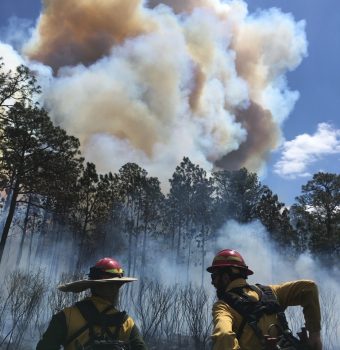
Smoke column at the Pine Island Burn Unit
Jay McIlwain (Natural Resource Manager at Grand Bay NERR) and Scott Saucier (former Prescribed Fire Specialist at USFWS) after lighting a head fire as part of a prescribed burn adjacent to Bayou Cumbest in the Grand Bay NERR.
what we do
Our work is designed to study the effects of traditional and novel approaches for restoration and management of coastal uplands and to share what we are learning with end-users to improve resource conservation across the region. The Grand Bay National Estuarine Research Reserve in Moss Point, MS is our living laboratory where we are actively conducting and studying restoration of pine savanna and flatwoods habitats.

Monitoring the Cottonmouth management unit
Andrew Heaton (Resource Monitoring Specialist at Grand Bay NERR) preparing to collect abiotic data (e.g., photo points, soil temps, photosynthetically active radiation) at a recently burned management unit on the marsh-upland ecotone.

Clewell plots at Savanna Trail
Nathan McGregor (MSU Extension Associate/Grand Bay NERR Stewardship Assistant) is assisting with running transects for vegetation monitoring using Clewell plots. Clewell plots are named after their designer Dr. Andre F. Clewell who developed this method to measure vegetation response to grassland restoration.

Debris removal at Grand Bay NERR
Grand Bay NERR staff conduct regular debris removal at the Reserve. Recent efforts have been focused on upland habitats where home sites were located historically. Since 2018, GNDNERR staff have disposed of over 38,000 lbs of debris.

Waterfowl education and outreach
Nathan McGregor (MSU Extension Associate/Grand Bay NERR Stewardship Assistant) is presenting information to industry partners about waterfowl ecology including how to construct nest boxes for wood ducks.

Grand Bay Savanna Complex
This map shows the boundaries of the Grand Bay National Wildlife Refuge, Grand Bay NERR, the Forever Wild Lands, and lands owned by the Alabama Department of Conservation and Natural Resources. Collectively this area is called the Grand Bay Savanna Complex and contains over 44,000 acres of public lands in conservation.

Henslow’s sparrow monitoring
Jonathan Pitchford (MSU Assistant Extension Professor/Grand Bay NERR Stewardship Coordinator) holding a Henslow’s sparrow that was caught in a mist net as part of a research effort by North Carolina State University and supported by MSU researchers. Henslow’s sparrows migrate south to winter in open grassland habitats that receive frequent prescribed fire.

Prescribed burn at Deer Island
Grand Bay NERR staff work collaboratively with the Mississippi Department of Marine Resources Coastal Preserves on a variety of projects. This photo was taken during a prescribed burn at Deer Island along some of the natural beach habitat.

Post-burn wiregrass resprouts
This management unit at GNDNERR was burned about 10 days before this photo was taken. The photo shows the re-emergence of many green shoots from Aristida stricta, a common wiregrass species in upland habitats at Grand Bay. Wiregrass is a fire adapted species that has evolved with fire and has higher seed production in the fall season following burns.

Bird surveys at Hawk’s Marsh
Nathan McGregor (MSU Extension Associate/Grand Bay NERR Stewardship Assistant) conducting a bird survey adjacent to Hawk’s Marsh in the Grand Bay National Wildlife Refuge.

Timber!!!
Jay McIlwain (GNDNERR Natural Resource Manager) and Jonathan Pitchford (MSU Assistant Extension Professor/GNDNERR Stewardship Coordinator) bucking up a slash pine tree as part of a collaborative research effort with Auburn University (Dr. Joseph Fan) to study slash pine growth in estuarine influenced habitats.

Master Naturalists on the Savanna Trail
The Grand Bay NERR Savanna Trail is a great place to see seasonal flowering plants in a fire-maintained wet pine savanna. More than 30 species of plants are found in one square meter in places like these, which makes them the most diverse vegetation communities in the U.S. The MSU Master Naturalists come in the fall season each year to learn about these habitats.

Basal Area and Tree Density Monitoring
Mike Archer (Coastal Ecologist at GNDNERR) is conducting basal area and tree density monitoring in a pine flatwood at GNDNERR to quantify timber resources. This data can be evaluated with vegetation and avian community data to identify target basal area and tree densities that maximize diversity.